
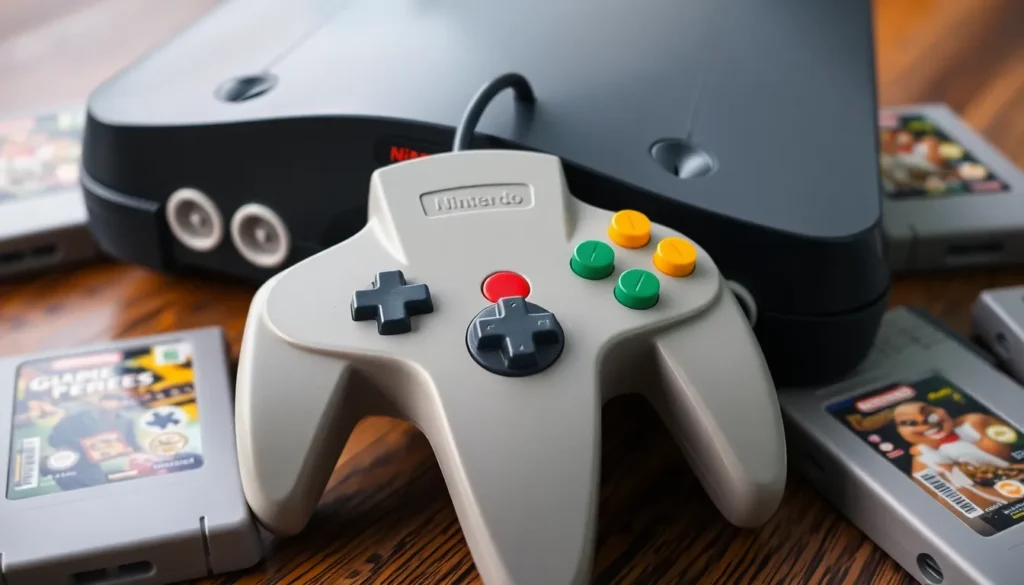
The Nintendo 64 system isn’t just a console; it’s a time machine that whisks players back to the golden age of gaming. With its iconic controller that looks like a futuristic spaceship and games that turned friendships into epic rivalries, it’s no wonder nostalgia hits hard when reminiscing about those pixelated adventures. From racing in “Mario Kart 64” to exploring the vast lands of “The Legend of Zelda: Ocarina of Time,” this system brought a whole new dimension to gaming—literally!
But let’s face it, the N64 isn’t just about the games. It’s about those unforgettable moments spent huddled around the TV, arguing over who gets to be Mario or desperately trying to perfect that tricky jump in “Super Mario 64.” Dive into the world of the Nintendo 64 and discover why this beloved classic still holds a special place in gamers’ hearts today.
Overview of the Nintendo 64 System
Launched in 1996, the Nintendo 64 marked a significant leap in gaming technology. The system utilized a 64-bit architecture, offering enhanced graphics and immersive gameplay experiences compared to its predecessors. Players enjoyed titles that employed 3D graphics, setting a new standard in game development.
Controllers played a crucial role in the N64 experience. The unique three-pronged design featured a joystick, which revolutionized how users interacted with games. Buttons were strategically placed for easy access, enhancing gameplay fluidity, particularly in competitive multiplayer scenarios.
A library of over 300 games contributed to the N64’s lasting legacy. Notable titles like “Super Mario 64,” “GoldenEye 007,” and “The Legend of Zelda: Ocarina of Time” showcased innovative gameplay mechanics. These games introduced open-world exploration and multiplayer functions, influencing countless future releases.
The console’s cartridges, while limiting storage in comparison to CDs, provided faster load times. This characteristic ensured uninterrupted gaming sessions, a key factor for many players. Additionally, the N64 supported four controller ports, facilitating local multiplayer fun.
Nintendo’s strategic marketing and iconic characters played a vital role in the system’s success. Mario, Link, and other beloved figures became synonymous with the N64 era, attracting diverse audiences. The console’s distinct identity solidified a passionate fanbase, fostering a sense of community among gamers.
The Nintendo 64’s innovative technologies, memorable titles, and iconic design created an unforgettable gaming experience. Its impact on the industry continues to influence game design and culture, underscoring its significance in gaming history.
Historical Significance

The Nintendo 64 stands out as a pivotal moment in gaming history. Launched in 1996, it marked a transition to 3D gaming with innovations that shaped the future of video games.
Launch and Release
At its release, the Nintendo 64 captured attention with its impressive 64-bit technology. Enthusiasts anticipated the innovative capabilities of the console, which included four controller ports for local multiplayer gaming. Officially unveiled in Japan on June 23, 1996, the North American launch followed on September 29, 1996. Initial titles, including “Super Mario 64” and “Pilotwings 64,” showcased the console’s potential and drew players into vibrant 3D worlds. Doughnut-shaped cartridges optimized performance, enabling faster load times compared to contemporary competition. Such features contributed to the system’s early appeal, allowing it to become a staple in households around the globe.
Key Competitors
In the mid-1990s, the Nintendo 64 faced formidable competition from several gaming platforms. Sega’s Saturn and Sony’s PlayStation emerged as prominent rivals, each offering their unique advantages. While the PlayStation championed CD-ROM technology, boosting storage capacity for games, the N64 emphasized high-quality 3D graphics and gameplay experiences. Both rivals targeted similar demographics, intensifying the competition for market share. Despite the fierce competition, Nintendo’s strategic focus on family-friendly gaming offered a distinct identity. This focused marketing approach drew in diverse audiences, allowing the N64 to remain relevant in a shifting gaming landscape.
Technical Specifications
The Nintendo 64 stands out with its robust technical specifications, which enhance the gaming experience and showcase its advanced capabilities.
Hardware Features
A 64-bit CPU drives the N64, providing powerful processing capabilities for its time. Efficient memory architecture includes 4 MB of RAM, which can expand to 8 MB with an optional expansion pack. The unique cartridge formats allow for quicker load times, minimizing interruptions during gameplay. It also supports advanced graphics, such as texture mapping and anti-aliasing, creating visually rich environments. Dual joystick and trigger configurations on its controller deliver precision in gameplay, further enhancing user interaction.
Game Design Capabilities
The N64’s architecture supports expansive game worlds and innovative mechanics. Developers utilized its advanced graphics to create detailed 3D environments, transforming player engagement. Open-world exploration became a signature feature in titles like “The Legend of Zelda: Ocarina of Time”. Multiplayer capabilities are integrated seamlessly, accommodating four controllers for local gaming fun. Its hardware also facilitates unique gameplay experiments, allowing for inventive narrative designs within numerous game genres. Such capabilities led to the creation of iconic experiences that shaped future video game development.
Iconic Games and Franchises
The Nintendo 64 boasts a library filled with memorable titles that defined gaming for a generation. Fans often cite games like “Super Mario 64,” the first true 3D platformer. “The Legend of Zelda: Ocarina of Time” set new standards for storytelling and exploration in video games. “Mario Kart 64” popularized multiplayer racing, fostering countless friendships and rivalries. “GoldenEye 007” revolutionized first-person shooters, introducing split-screen multiplayer that many still cherish today. Each of these games not only entertained players but also showcased the N64’s capabilities.
Major Titles
“Super Mario 64” remains one of the most influential games, establishing the mechanics of free exploration in 3D space. “The Legend of Zelda: Ocarina of Time” earned critical acclaim for its engaging narrative and open-ended gameplay. “Mario Kart 64” brought families together with competitive yet friendly races. “GoldenEye 007” paved the way for future multiplayer shooters, blending engaging gameplay with iconic levels. Collectively, these titles helped the N64 secure its place in gaming history.
Impact on Gaming Culture
The Nintendo 64 made a significant impact on gaming culture, introducing innovative mechanics that players embraced. Multiplayer gaming found new life through local competitions, leading to social gatherings centered around the console. The rise of franchises like “Mario” and “Zelda” shaped a generation’s gaming experiences. Enthusiasts still analyze and celebrate N64 games, contributing to online communities dedicated to retro gaming nostalgia. Its iconic controller design influenced the future of user interface, making gaming more accessible and engaging.
Legacy and Influence
The Nintendo 64 left an indelible mark on the gaming landscape. Its innovations radically changed gameplay experiences and future console designs.
Innovations Introduced
Revolutionary features defined the N64’s gaming approach. 3D graphics transformed how players interacted with virtual worlds, showcasing depth and realism. An intuitive controller with dual joysticks allowed for fluid motion and precision. Local multiplayer capabilities brought friends together, fostering a vibrant social gaming scene. Notable gameplay mechanics, including open-world exploration in “Super Mario 64,” set new standards that influenced many subsequent titles.
Lasting Impact on Future Consoles
Future consoles drew inspiration from the N64’s design and technology. The development of analog sticks became a staple in gaming controllers, enhancing player control. Influences extend to 3D game environments across platforms, resulting in expansive worlds and immersive experiences. Game developers adopted and expanded the multiplayer features originally popularized by the N64. Innovations established during its era helped shape the evolution of gaming, leading to the modern gaming experience seen today.
The Nintendo 64 stands as a landmark in gaming history. Its innovative technology and memorable titles created experiences that resonate with players even today. The console not only transformed how games were played but also fostered connections among friends and family.
As a pioneer in 3D gaming and local multiplayer experiences, the N64 set the stage for future advancements in the industry. Its legacy continues to inspire developers and gamers alike, ensuring that the spirit of the Nintendo 64 lives on through both nostalgia and ongoing appreciation. The impact of this beloved console is undeniable, solidifying its place in the hearts of gamers everywhere.


